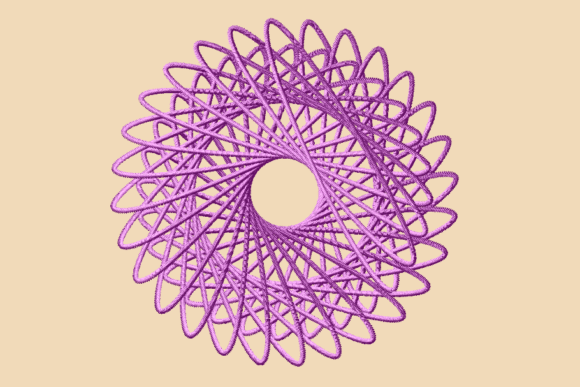
Purple Mandala Satin
First Impressions: Calm, Rich, and Purposefully Balanced
Opening the Purple Mandala Satin file feels like unrolling a quiet invitation—not loud or flashy, but deeply intentional. As a designer who’s stitched hundreds of mandalas across apparel, home goods, and boutique accessories, I immediately notice how this one breathes. The shape isn’t overly symmetrical to the point of rigidity, nor is it so freeform that it loses its centering power. It lands somewhere between sacred geometry and modern minimalism—clean lines, layered petals, subtle gradations in stitch density, and a generous negative space core that lets fabric show through. That openness matters. It means the design won’t overwhelm delicate baby onesies or compete with textured linen tea towels. It also means Purple Mandala Satin reads as thoughtful, not decorative filler.
A Real-World Test: Embroidering a Linen Tote for a Local Boutique
Last week, I used Purple Mandala Satin on a natural linen tote—intended for a small-town gift shop carrying handmade ceramics and botanicals. We placed it centered on the front panel, about 4.5" wide. The result? Instant cohesion. The violet tone (when stitched in high-quality 40-weight rayon) didn’t shout—it deepened the linen’s warmth, adding quiet luxury without looking costumed or “crafty.” Customers paused. They touched the satin stitch petals. They asked, “Is that hand-stitched?” That’s the signal: when people assume handwork, your machine embroidery has earned trust.
Where It Shines—and Where It Needs Careful Handling
- Custom apparel: Works beautifully on medium-weight cotton sweatshirts and structured canvas jackets—but avoid placing it directly over seams or shoulder yokes where fabric tension distorts satin stitch flow.
- Tote bags & pillow covers: Ideal. The balanced scale and open center prevent puckering on thicker weaves. Just use medium-cutaway stabilizer—no need for heavy backing unless stitching on recycled denim.
- Baby embroidery: Soft, non-bulky, and soothing visually—perfect for organic cotton burp cloths or muslin swaddle blankets. Avoid dense fill areas near necklines where stitching could irritate sensitive skin.
- Embroidered patches: Yes, but size matters. At under 3", fine details (like inner petal outlines) may blur. Stick to 3.5"–5" for crispness in finished patch form.
- Dark or textured fabrics: Satin stitch catches light differently here. On charcoal terry cloth or heathered fleece, test thread contrast first—deep plum or eggplant tones read richer than lavender. Also, pre-shrink textured fabrics; distortion after washing can warp delicate outer loops.
What This Design Says About Your Brand—Without Words
Purple Mandala Satin doesn’t scream “trend.” It whispers “intention.” That distinction matters if you’re an Etsy seller positioning your handmade product as mindful, or a small shop owner curating pieces with longevity. It elevates perceived value—not by adding bling, but by signaling care in composition and restraint. When stitched on a kitchen towel for a wedding gift, it feels personal, not mass-produced. When used as a subtle chest accent on a black apron for a café’s staff uniform, it adds identity without branding overload. And for digital product sellers? This is strong design asset material—versatile enough for printable mockups, yet distinctive enough to stand out in a crowded embroidery marketplace.
Practical Designer Notes Before You Stitch
- Always run a test on scrap fabric matching your final project’s weight and stretch—especially for curved surfaces like caps or baby hats.
- Check stitch density in the outer rings. If it reads too solid, consider reducing fill density by 5–10% for better drape on soft knits.
- Review small corners and connecting stems. Some mandala files over-detail fragile joins—Purple Mandala Satin avoids that, but still verify on your machine.
- Use proper stabilizer: tear-away for stable wovens, cut-away for knits or lightweight silks. Skip fusible web unless absolutely necessary—it dulls satin stitch sheen.
- Test thread colors in both natural and artificial light. Violet shifts dramatically—what looks royal at noon may read grayish under store lighting.
- Confirm licensing before selling finished items. Since this falls under Shapes and Embroidery, double-check whether commercial use is permitted for physical products or digital resale.
- Try a black-and-white mockup. If the design holds visual weight without color, you’ve got strong silhouette integrity—a hallmark of professional machine embroidery design.
Final Thought: Not Just Another Mandala
There are dozens of mandala embroidery files online. Most are either too busy or too sparse. Purple Mandala Satin earns its place because it respects the fabric, the wearer, and the maker’s time. It stitches cleanly, photographs well, and translates across categories—from a personalized gift for a yoga instructor to a signature motif for a slow-fashion label. It’s not flashy. It’s focused. And in today’s market, where authenticity beats volume every time, that focus is your quiet advantage.