Native American Embroidery Patterns
A Designer’s First Look: Bold, Balanced, and Built for Meaning
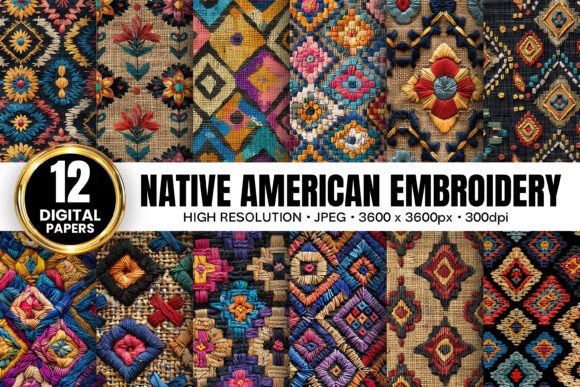
When I opened the ZIP file for Native American Embroidery Patterns, my first thought wasn’t “pretty”—it was “present.” These aren’t decorative filler motifs. They carry weight in their symmetry, rhythm, and restraint. Twelve seamless digital papers—each 3600 × 3600 pixels at 300 DPI—arrive as high-res JPGs, clean and ready for adaptation. No vector files, no layered PSDs, no embroidery-ready stitch files—but that’s not a flaw here. It’s a signal: this is source material, not a plug-and-play machine embroidery design. As someone who regularly translates patterns into stitched reality, I appreciate that upfront honesty.
Real-World Test: A Hand-Embroidered Tote for a Local Boutique
Last week, I used one of the patterns—a geometric sunburst with interlocking chevrons—as the central motif on a heavyweight organic cotton tote for a small-town gift shop. I traced it onto fabric, chose matte cotton floss in terracotta, ochre, and deep indigo, and worked slow satin and running stitches by hand. The result? Crisp lines, clear negative space, and a warmth that photographs well *and* feels grounded in person. Customers didn’t just notice it—they paused. Asked about its origin. That’s the quiet power of these Native American Embroidery Patterns: they invite attention without shouting. They suit products where storytelling matters—nursery decor, wedding guest towels, artisanal aprons, or limited-run sweatshirts for cultural events.
Where They Shine (and Where They Ask for Care)
These patterns excel in medium-to-large applications: pillow covers, tea towels, baby blanket corners, and custom patches meant for visible placement. Their seamless nature makes them ideal for all-over prints on fabric before stitching—or as a base for hand-embroidered accents. On a structured cap? Use sparingly—choose a simplified repeat or isolate one central element. On stretchy knit sweatshirts? Pair with light cutaway stabilizer and reduce fill stitch density manually if digitizing later. On dark fabric? Test contrast early: some motifs rely on subtle tonal shifts that fade on black or navy unless you adjust thread colors intentionally.
- Tote bag design: Strong visual impact at 8–12 inches wide; holds up beautifully in both hand and machine work.
- Sweatshirt embroidery: Best as a chest accent or back panel—not tiny sleeve detail. Avoid dense inner corners if digitizing.
- Baby embroidery: Gentle geometry reads softly on onesies and burp cloths—no sharp points or overly tight repeats.
- Holiday embroidery: Works year-round, but especially resonant for autumn collections, Indigenous Peoples’ Day gifts, or heritage-themed weddings.
- Commercial embroidery: Highly adaptable for boutique branding—just ensure your digitizer respects the pattern’s inherent spacing and line weight.
What Designers Need to Know Before Stitching
Because these are graphics, not pre-digitized embroidery files, your next step depends on your workflow. If you’re hand-embroidering: trace freely, scale confidently (the resolution supports crisp enlargement), and trust the balance of positive/negative space. If you’re digitizing for machine use: inspect each pattern for fine interior lines—some may need slight thickening to avoid fragile satin columns or skipped stitches. Always test on scrap fabric first, especially with textured weaves like linen or terry cloth. And yes—check licensing before selling finished items. The product description doesn’t state commercial rights, so verify before listing on Etsy or bundling into a craft business kit.
Stitching Clarity ≠ Visual Simplicity
Don’t mistake clean lines for low effort. These Native American Embroidery Patterns reward intentionality. A tightly spaced zigzag repeat might look elegant on screen but translate into high stitch density—potentially stiffening lightweight fabrics or causing puckering without proper tear-away stabilizer. Conversely, the open-chevron motifs breathe well on quilting cotton or chambray, letting thread texture and fabric drape shine through. For personalized gifts—say, a monogrammed kitchen towel with a border repeat—the pattern adds gravitas without overwhelming the personal touch.
Brand Trust, Not Just Aesthetic Appeal
As an Etsy seller and small shop consultant, I’ve seen how culturally rooted patterns influence buyer perception. Used respectfully—with context, credit where appropriate, and thoughtful application—these designs elevate handmade presentation and deepen customer connection. But they also demand awareness: avoid pairing them with stereotyped phrasing or mass-produced clichés. A well-executed embroidered patch using one of these patterns feels intentional, curated, and quietly confident. A rushed, oversized version on a polyester blend cap? It risks flattening meaning into ornament. Your role isn’t just technician—it’s interpreter.
Practical Designer Notes You’ll Actually Use
- Test the pattern on your actual fabric—not just white printer paper—before cutting or hooping.
- Check thread color contrast in natural light *and* under store lighting; some earth tones shift dramatically.
- Review stitch density manually if digitizing—especially around repeated angles and narrow bands.
- Confirm hoop size compatibility: large repeats may require 6"×10" or larger hoops for full clarity.
- Inspect small details at 200% zoom—if a line vanishes or blurs, it likely won’t stitch cleanly.
- Try a black-and-white mockup: if the pattern loses legibility without color, simplify before embroidering.
- Compare performance on light vs. dark fabric backgrounds—you may need two thread palettes.
- Use cutaway stabilizer for knits, tear-away for wovens, and fusible for delicate layers like baby swaddle fabric.
- Distinguish between personal and commercial use early—this affects how you market the finished product.
Final Thought: A Quietly Versatile Asset
Native American Embroidery Patterns won’t replace your go-to florals or script monograms—but they’ll anchor a collection with integrity. They’re the kind of design asset that grows more useful the longer you own it: scalable, respectful in form, and flexible across mediums. Whether you’re stitching a single holiday gift or building a cohesive line of small shop products, these patterns offer substance without spectacle. Just remember: their strength lies not in how much they say, but in how thoughtfully you let them speak.